



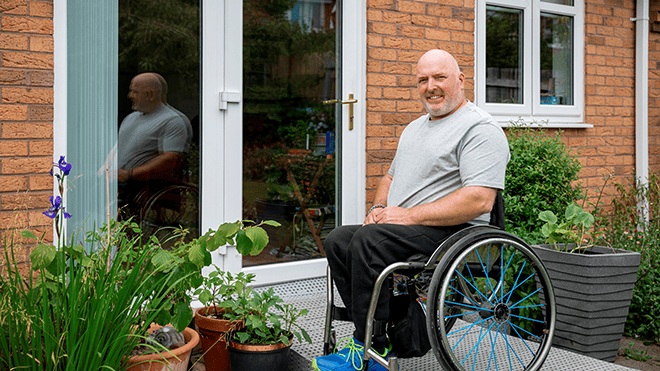
Spinal injury home care
Living with a spinal injury can bring major challenges to everyday life, but the right support at home can make all the difference.
Dovida offers a specialist home support service for people with spinal cord injuries who want to live safely, comfortably and independently in their own homes.
What is a spinal injury?
A spinal injury refers to any damage to the spinal cord that affects movement, sensation, or essential bodily functions.
This can happen through an accident, illness or medical condition.
What is spinal injury care?
Depending on the level and severity of the injury, you may experience:
- Reduced or limited movement
- Changes in sensation or feeling
- Bladder or bowel changes
- Difficulty regulating temperature or blood pressure
- Increased risk of pressure sores
- Respiratory difficulties
- Changes in how you eat and drink
- Low mood and anxiety
If these changes affect your daily life, homecare can provide the support you need to stay safe and maintain your independence.
About our spinal injury care services
At Dovida, you are at the centre of your care and support. We tailor our specialist spinal injury home support service to your goals, lifestyle and the level of assistance you want to ensure you live your life, your way.
Our nurse-led team of home healthcare assistants can support you with:
Transition Planning
- Working with you, your family and healthcare team to plan your discharge home.
Personal Care
- Assistance with washing, dressing and grooming
- Safe transfers and mobility support
- Skin care and pressure relief routines
- Bowel and bladder management
- Support with eating, drinking and nutrition
Specialist Clinical Care
- Neurogenic bowel and bladder care to include catheter flushing and clean intermittent catheterisation
- Monitoring for infections and autonomic dysreflexia
- Medication administration
Independence and Rehabilitation Support
We help you build confidence and maintain independence through:
- Daily living skills
- Safe mobility techniques and transfers
- Supporting exercise routines e.g. motomed
- Supporting passive stretching e.g. tilt table
- Supporting you to work, study and socialise outside of your home
“There are a lot of benefits by putting on a tilt table because my life is spent predominantly lying down or sitting in the chair here. Because of my disability, I don’t stand. I haven’t stood since before the accident. One of the benefits of being on a tilt table is that it improves your posture, your back, and it also helps to get your blood pressure back to near normal.”
Spinal Injury Home Support client supported by Dovida staff to use the tilt table
How Dovida can support you through spinal injury care
We believe that everyone deserves to live with dignity, comfort, and choice in their own home. Our role is to provide expert, compassionate care and support that adapts to your needs – whether your injury is recent or long‑standing.
We work with you, and your existing care team (including the National Rehabilitation Hospital) to develop your care and support plan and support you to transition from hospital to home.
Our team of home healthcare assistants is nurse-led. They are specifically trained to support people with spinal cord injury. We can provide support as and when you need it, from a few hours a week to 24/7 support 365 days each year.
Services can be funded by the HSE or privately depending on your circumstances.
Meet our Enhanced Services Team

Paula Trainor
National Lead for Enhanced Services
We build a dedicated team of home health care assistants around the person with a spinal cord injury.
This team is led by a local NMBI-registered nurse who works with our National Lead for Enhanced Services, Paula Trainor.
Paula is both a Registered General Nurse and Public Health nurse and a former HSE Assistant Director of Public Health Nursing.
All our staff are experienced, Garda-vetted and trained to meet your needs.
Our nurses are trained by the National Rehabilitation Hospital in the Management of Neurogenic Bowel Care and the wider team has completed a range of other training to include manual handling, safe administration of medication, catheter care and catheter flushing, neurogenic bowel care, using the tilt table, recognising the signs of autonomic dysreflexia, skin integrity and infection, prevention and control.
The benefits of home care for individuals with spinal injury
Home support for people with a spinal cord injury delivered by Dovida offers major benefits – it speeds up safe discharge from hospital, protects long term health, improves independence and quality of life.
Faster, safer discharge from hospital
Many people with Spinal Cord Injury are medically ready to leave hospital but face a delayed transfer of care to the community because they cannot be discharged safely without community support.
Dovida is one of the only home support companies in Ireland to offer a specialised service to individuals with spinal cord injury. We know that by training our staff in essential tasks, especially neurogenic bowel care, we have removed one of the biggest barriers to discharge.
Getting home early prevents the “regression” and loss of confidence that can happen during long hospital stays. Our service also means that you may be able to avoid transfer to a nursing home whilst care is being arranged for you.
Improved health, safety and complication prevention
Our specialist homecare team helps prevent:
- Autonomic dysreflexia
- Recurrent infections
- Skin breakdown and pressure injuries
- Unnecessary readmissions to acute care
Greater Independence and Daily Living Support
Dovida’s home support service enables people to:
- Rebuild routines and regain control of their day
- Sleep in their own bed, see family and resume meaningful activities
- Receive help with transfers, personal care, bowel / bladder routines, and mobility
- Use assistive technologies and home modifications to increase independence (e.g. ramps, adapted bathrooms, voice or eye controlled devices)
Psychological and Emotional Benefits
It’s often said, “There’s no place like home”. Being at home reduces stress associated with long hospital stays, and allows you to relax in your own surroundings with the things and people that you love.
We find that starting a home support service takes a little time for people to get used to, but after a while the team that supports you will blend right into your daily routine and life.
Support for families and carers
Home support delivered by Dovida reduces the physical and emotional toll on family members. With Dovida supporting your personal care and intimate tasks such as bowel care, you and your family members can relax and know that everything is taken care of.

They saw the person. They saw that he wanted to get home and they were very, very, very much person-centred, which I found absolutely excellent.
It was just the fact that they looked at the person they pulled out all the stops to make sure that this person got home because they knew that that was his will and preference.
Without Dovida, I can’t imagine any other agency to manage that and manage how they built the team around this individual. And that’s the key.
Why choose Dovida for spinal injury care services?
A dedicated team
Dovida has developed a dedicated Spinal Cord Injury Home Support Service, designed specifically for adults living with SCI.
This service was piloted and scaled nationally to address a major gap in community care – safe, skilled support that enables people to leave hospital sooner and live well at home.
Our teams understand the complex needs associated with spinal injuries, including:
• Neurogenic bowel and bladder routines
• Skin integrity and pressure‑injury prevention
• Autonomic dysreflexia awareness
• Safe transfers and mobility support
• Infection‑prevention and daily health monitoring
This level of expertise helps prevent avoidable complications and reduces hospital readmissions.
Faster, safer, discharge home
Delayed transfers of care are a major issue for people with spinal injuries – often due to lack of trained home support. Dovida’s SCI service directly addresses this barrier, enabling people to return home sooner, safer, and with confidence.
At the National Rehabilitation Hospital conference, experts highlighted that many delays are preventable when the right community supports are in place – exactly what Dovida provides.
Person-centred care, built around your life
Dovida’s entire model is built on one principle: Your Life, Your Way.
We place each person at the centre of their care and support plan, working closely with families, clinicians, and multidisciplinary teams to deliver support that reflects your goals, preferences, and daily routines.
This includes:
• Flexible scheduling
• Tailored care plans
• Support for independence and community participation
• Respectful, relationship‑based care

Ireland’s leading home care provider
Dovida supports thousands of people across Ireland every day, including those living with spinal cord injury, acquired brain injury, MS, MND, Parkinson’s, and other complex conditions. We deliver consistent, high‑quality care wherever you live.
A team built on genuine connection
Dovida was founded on the belief that the best care comes from real, meaningful relationships.
Our name, combining the Latin words for home (domus) and life (vida), reflects our mission: to help people live the life they choose, at home, for as long as possible.
Caregivers are selected not only for their skills, but for their compassion, empathy, and commitment to dignity and respect.
Proven impact – real lives changed
Dovida’s SCI service has already helped people:
• Move safely from hospital back to their own homes
• Transition out of nursing homes into independent living
• Reunite with family sooner
• Regain control of their daily routines and quality of life
These outcomes demonstrate the transformative power of specialist home support.
How long does it take for a spinal injury to heal?
Every spinal cord injury is different, and recovery varies from person to person.
In general, the spinal cord does not “heal” in the same way as a broken bone, but many people do experience improvement over time – especially with the right rehabilitation and home support.
What to expect
• Most recovery happens in the first 3–6 months, as swelling reduces and the nervous system begins to stabilise.
• Progress can continue for up to 18 months, sometimes longer, particularly with incomplete injuries.
• Complete injuries (where there is no movement or sensation below the injury) have a lower chance of regaining significant function, but rehabilitation still plays a major role in independence and quality of life.
• Long‑term recovery focuses on building strength, preventing complications, and adapting daily routines for maximum independence.
Even though healing takes time, people are often discharged home long before recovery is complete. Specialist home support helps with:
• Personal care and daily routines
• Bowel and bladder management
• Skin care and pressure‑injury prevention
• Safe transfers and mobility
• Confidence and independence at home
This support ensures a safer recovery and reduces the risk of complications or hospital readmissions.
What are the different types of spinal injury care?
People with a spinal cord injury often need a combination of medical, rehabilitation, and home‑based supports. The exact care depends on the level of injury (cervical, thoracic, lumbar, sacral) and whether the injury is complete or incomplete. Below are the main types of care someone may receive.
1. Acute Hospital Care
This is the immediate care provided after the injury. It focuses on:
• Stabilising the spine
• Preventing further damage
• Managing swelling and inflammation
• Surgery if required
• Early respiratory and skin‑integrity management
This phase usually happens in a trauma centre or specialist hospital
2. Specialist Rehabilitation
Once medically stable, people move into rehabilitation to regain as much function and independence as possible. This may include:
• Physiotherapy
• Occupational therapy
• Seating and posture management
• Assistive technology assessments
• Education on bowel, bladder, and skin care
• Psychological support
Rehabilitation can continue for months or years.
Home Support & Community Care
This is where most long‑term recovery and daily living support happens. Home care may include:
• Personal care (washing, dressing, grooming)
• Bowel and bladder routines
• Skin care and pressure‑injury prevention
• Safe transfers and mobility assistance
• Medication prompts
• Meal preparation and household support
• Community participation and social support
Specialist providers like Dovida offer trained teams who understand the unique needs of spinal injury.
4. Nursing & Clinical Oversight
Some people require ongoing clinical input at home, such as:
• Wound and skin management
• Catheter care
• Monitoring for autonomic dysreflexia
• Infection prevention
• Support with respiratory equipment (for higher‑level injuries)
Nurses may work alongside home‑support teams to ensure safety and continuity of care. Dovida’s specialist spinal cord injury home support service includes nursing and clinical oversight.
5. Long‑Term Management & Lifestyle Support
Spinal injury care is lifelong. Ongoing support may include:
• Regular reviews with rehabilitation consultants
• Wheelchair and equipment updates
• Home adaptations (ramps, accessible bathrooms, hoists)
• Peer support and counselling
• Vocational or educational support
• Community reintegration
How can I find spinal injury care services?
After your acute injury, you may spend some time in a rehabilitation unit such as the National Rehabilitation Hospital. After that, it’s time to consider support at home and that’s where Dovida can support you.
We also recommend linking in with Spinal Injuries Ireland to find out more about services available to help you adjust to like after injury and stay connected.
How much does spinal injury home care cost?
Spinal Injury Home Care costs vary by provider. Care is usually funded by the HSE. Contact Dovida to find out more about our services and rates.
How can I prepare for spinal injury care?
Preparing for spinal injury care involves planning ahead, organising the right supports, and making sure your home environment is safe and accessible. Good preparation reduces stress, prevents complications, and helps settle into daily life with confidence.
1. Prepare Your Home Environment
A safe, accessible home is essential. Common preparations include:
• Ramps or step-free access at the entrance
• Widened doorways for wheelchair access
• Bathroom adaptations such as grab bars, a roll‑in shower, shower chair, or raised toilet seat
• A suitable bed setup, often adjustable in height
• Clear, clutter‑free pathways for easy movement
These changes help prevent falls, pressure injuries, and unnecessary strain on caregivers.
2. Arrange the Right Equipment
Your hospital or rehab team will recommend equipment such as:
• Wheelchair or power chair
• Pressure‑relieving cushions
• Hoists or transfer aids
• Catheter and bowel‑care supplies
• Skin‑care and wound‑care materials
Having these ready before discharge makes the transition home much smoother.
3. Plan Your Caregiver Support
Most people with a spinal injury need daily assistance, especially early on. Preparation includes:
• Identifying who will help with transfers, personal care, bowel/bladder routines, and mobility
• Training family members or caregivers in safe techniques
• Arranging professional home support if needed (e.g., specialist SCI homecare providers)
A clear care plan reduces stress and ensures everyone knows their role.
4. Learn Key Health Skills
Understanding essential self‑care helps prevent complications. This includes:
• Skin care and pressure‑injury prevention
• Bowel and bladder management
• Recognising signs of infection
• Managing spasticity and pain
• Knowing when to seek medical help
Education is a major part of rehab, and families are encouraged to participate.
5. Organise Medical & Follow‑Up Care
Before coming home, make sure you have:
• All prescriptions filled
• Follow‑up appointments scheduled
• Contact details for your rehab team
• A plan for ongoing physiotherapy or occupational therapy
This ensures continuity of care and avoids gaps in treatment.
6. Prepare Emotionally
A spinal injury is a major life change. It’s normal to feel overwhelmed. Preparing emotionally may include:
• Speaking with a psychologist or counsellor
• Joining peer‑support groups
• Involving family in discussions about expectations and routines
Emotional readiness is just as important as physical preparation.
7. Create a Daily Routine
A predictable routine helps with:
• Medication timing
• Bowel and bladder schedules
• Skin checks
• Rest periods
• Therapy exercises
Consistency supports health, independence, and confidence.
Preparing for spinal injury care means getting your home, equipment, care team, and daily routines ready before discharge. With the right planning and support, home can be a safe, empowering place for recovery and long‑term independence.